

As the West pivots back toward reindustrialization, energy security, and supply chain resilience, the overlooked layers of the physical economy like maintenance, uptime, and logistics are becoming both constraints and opportunities.
For much of the past three decades, Western economic thinking assumed that globalization had permanently replaced industrial sovereignty. Manufacturing could be optimized globally. Supply chains could reliably stretch across oceans. Energy could be constrained domestically and sourced elsewhere. Financial efficiency would more than substitute for physical resilience.
Those assumptions and long held views on the global order are now being tested by reality. Geopolitical tensions, supply chain disruptions, and a growing recognition of strategic vulnerability have driven a renewed emphasis on industrial policy across the U.S. and Europe. In remarks at the Munich Security Conference, U.S. Secretary of State Marco Rubio delivered a wide-ranging address that encapsulated this shift.
I recommend you watch the full speech before reading the analysis and commentary. I watched it in full before reading all the pro and con articles I have provided below. I think it’s worth forming your own impression first, if you have the time, it’s 30 minutes well spent.
You can watch the full video or read the complete transcript on the official U.S. State Department website: https://www.state.gov/releases/office-of-the-spokesperson/2026/02/secretary-of-state-marco-rubio-at-the-munich-security-conference.
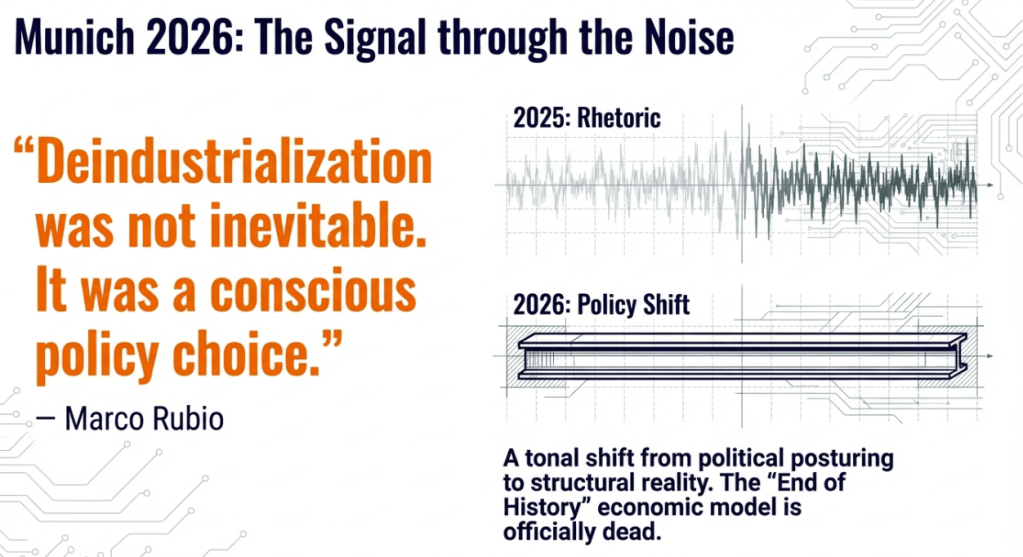
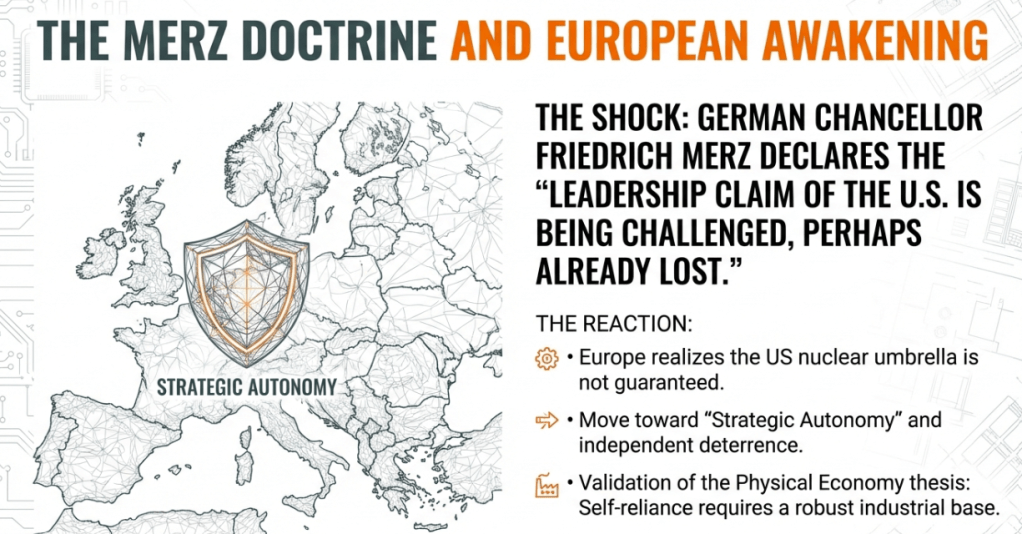
Rubio argued that the post–Cold War mindset assumed that “we had entered, ‘the end of history,’ and that trade and commerce alone would replace nationhood, a belief he said ignored “the lessons of over 5,000 years of recorded human history.” We are hearing these views from many others, ranging from Ray Dalio and his caution that we are entering Stage 6 of his framework on empires and global order, to Merz of Germany who declared that the “international order no longer exists“.
So, good or bad, we are clearly headed into something very different than the economic and geopolitical systems that have governed since the end of the cold war. So what now?

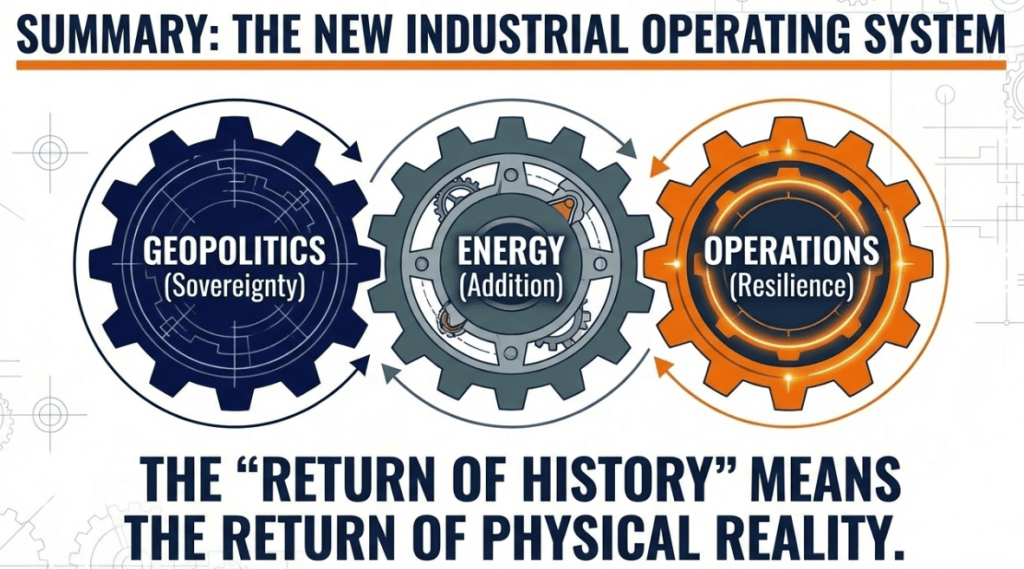
Reindustrialization Isn’t Just About Capacity, It’s About Operability
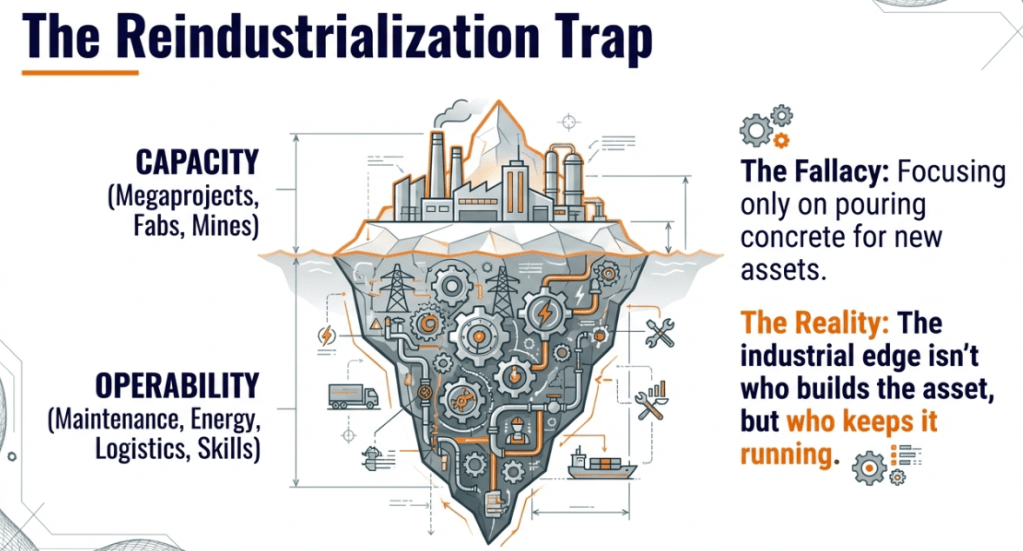
Headline announcements tend to focus on chip fabs, plants, mines, and megaprojects. Yet every industrial asset exists within an operating system of energy, logistics, materials handling, automation, and maintenance. These are the systems that determine whether industrial ambition can be translated into sustained output. These are also systems that need a lot of revitalization in the US.
Rubio was explicit that “deindustrialization was not inevitable. It was a conscious policy choice,” and pointed to the hollowing out of productive capacity and the offshoring of supply chains as strategic setbacks. But reversing this trend will require not only building capacity, but also ensuring that complex physical systems can be kept running reliably over time. This will require a realistic approach to energy supply and operational support systems.
Addressing these risks and building layers needed beyond the headline plant announcements favors businesses and operating models that invest in:
- Predictive and preventive maintenance
- Condition monitoring and reliability engineering
- Operational resilience under energy and supply constraints
- Energy supply reliability and optionality
- Logistical flexibility and utilization of multi-modal supply chains
Rebuilding a US industrial edge is not just about who builds the asset but who keeps it running.
An Energy System focused on Energy Addition and Scalability not only on Transition
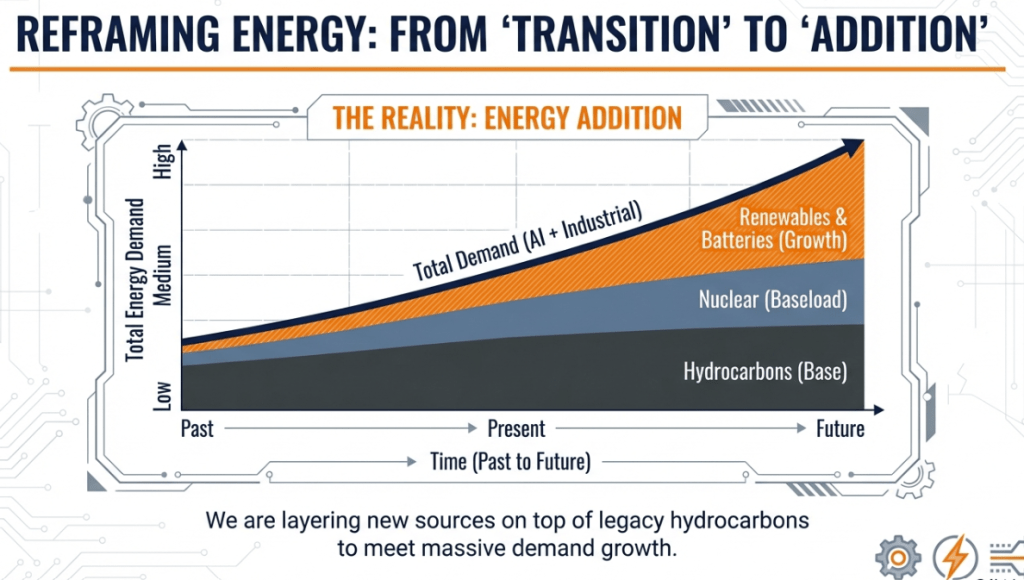
For the past two decades, energy policy has been discussed as a linear “energy transition” that would replace old fuels with new ones. In the real world, however, new energy sources and infrastructure are being added on top of existing ones and this is accelerating as overall energy demand grows.
This concept of energy addition better captures the structural reality:
- Modern industrialization increases total energy throughput rather than simply substituting one source for another
- Grid expansion, electrification, batteries, renewables, and legacy hydrocarbons coexist in a layered system
- Sustainability goals must be pursued in a way that respects resilience, reliability, and diversity of supply.
In this context, resilience is not a luxury but an economic input: the ability to rely on multiple energy layers that perform under stress. This means pushing back on misguided approaches that advocate dangerous dependency on any one energy resource, be it renewables, nuclear, gas, or oil, it doesn’t matter which. Too much of any one of them is a just a bad idea.
Resilience Is Becoming an Economic Input
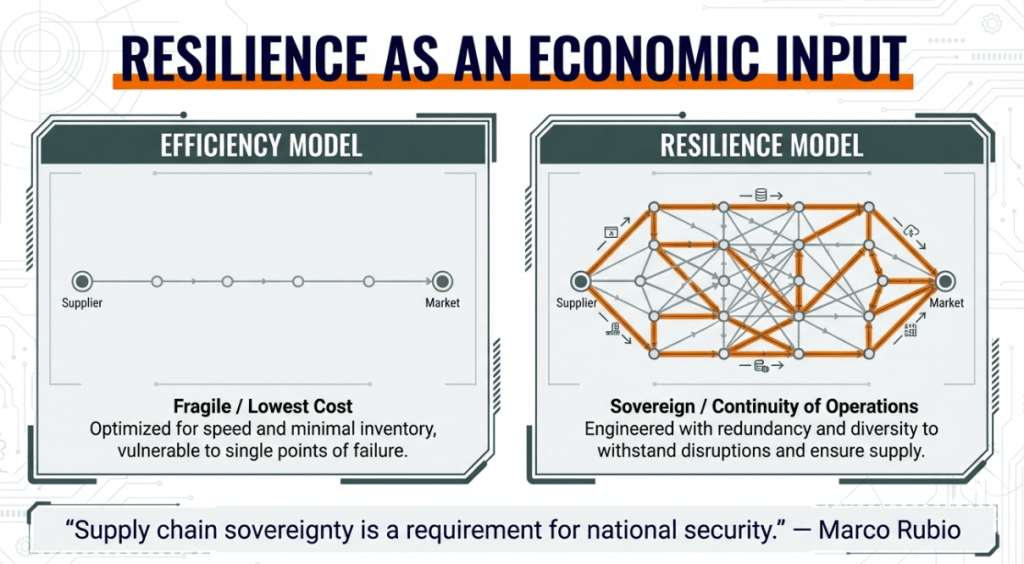
The past decade of Covid and a land war in Europe has exposed the fragility of hyper-optimized global supply chains. Efficiency, in isolation, proved brittle. In response, resilience is being reintroduced as a design constraint in industrial strategy.
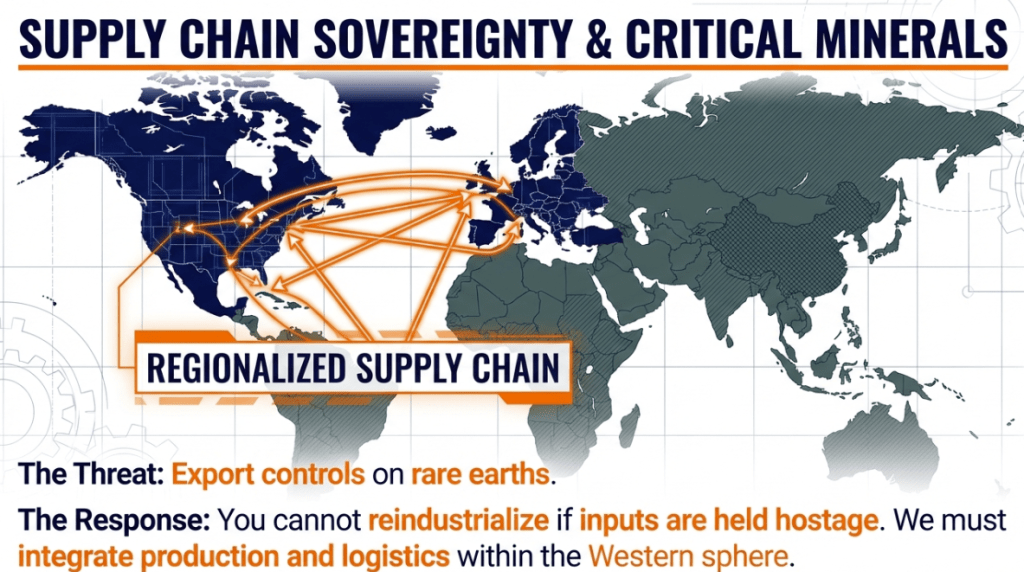
Rubio warned that the loss of “supply chain sovereignty” has left Western nations dependent on external suppliers in ways that undermine strategic autonomy. He then argues that the practical response is not isolationism but a rebalancing toward reliability: regionalization of supply chains, redundancy in critical inputs, and closer integration between production and logistics.
Resilience can no longer be treated as a contingency. It is increasingly treated as a form of economic capital; one that we will have to find a way to price into the economics of what we buy, supply and use. This new physical economy is being redesigned with continuity of operations as a primary objective, not a secondary consideration.
Uptime Economics Will Shape the Next Industrial Cycle
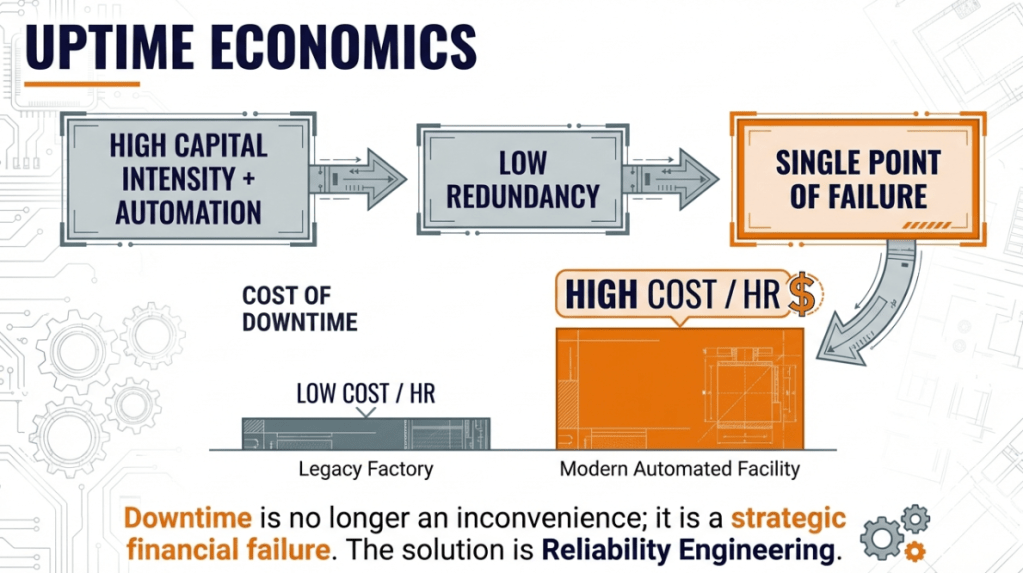
As automation deepens and facilities become more capital-dense, the cost of failure increases non-linearly. Robots coupled with the latest in industrial automation provide much of the productivity gains needed for the West to compete with billions of low cost laborors in Asia, but they also can introduce a single point of failure. Either a mechanical or energy-related disruption can quickly cascade through tightly coupled systems that are built for high throughput with limited redundancy.
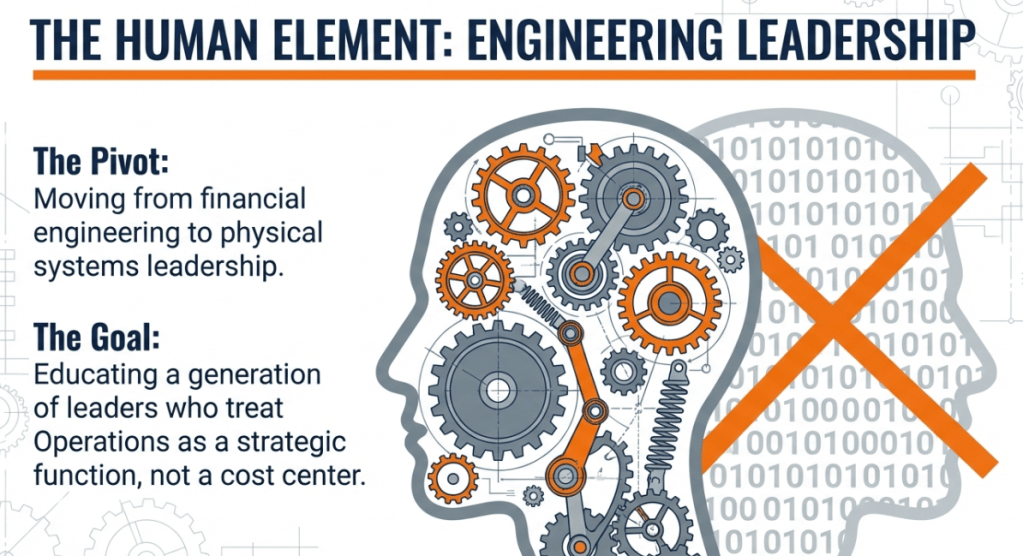
Rubio pointed to the strategic opportunity in “industrial automation and flex manufacturing,” as technologies that raise the bar for reliability and uptime economics. The operational disciplines that sit beneath these technologies such as maintenance, lubrication, thermal management, and reliability engineering all become more consequential as systems grow more complex and tightly integrated.
In practical terms, the next phase of industrial competition will be defined less by headline capacity additions and more by the quiet disciplines of uptime and systems engineering. These factors rarely make headlines, but they determine whether a much more automated industrial strategy can succeed in practice.
Viewing the Physical Economy as Strategic Infrastructure
Industrial policy is often discussed in terms of factories, trade, and geopolitics. But beneath these visible layers sits a quieter form of infrastructure: the physical systems that allow energy, materials, and machinery to operate continuously in the real world.
As US and hopefully European reindustrialization accelerates, this layer quickly becomes a binding constraint. Energy security and industrial capacity are not separate challenges; they are two sides of the same physical system. The ability to build assets is increasingly inseparable from the ability to power them and operate them reliably over time.
The return of industrial policy is, at its core, a return to physical reality. The next industrial cycle will be built not just on capital and policy, but on the operational foundations that allow complex systems to function under real-world conditions.
Read More for Further Insights
Primary Source:
Full speech and transcript — Secretary Rubio at the Munich Security Conference (official U.S. State Department) https://www.state.gov/releases/office-of-the-spokesperson/2026/02/secretary-of-state-marco-rubio-at-the-munich-security-conference
Pros – Generally Supportive Analysis:
What Rubio said in Munich, what Europe heard, and what comes next — Atlantic Council analysis on the speech’s themes and reception. https://www.atlanticcouncil.org/content-series/fastthinking/what-rubio-said-in-munich-what-europe-heard-and-what-comes-next
Rubio calls on Europe to work together while advocating Trump-aligned policies — SAN News overview of general reactions. https://san.com/cc/rubio-says-in-munich-us-wants-to-work-with-europe-while-keeping-trump-policies/
Euronews coverage: Rubio’s call for shared destiny and cooperation — summary of key points from Munich. https://www.euronews.com/my-europe/2026/02/14/munich-security-conference-rubio-calls-on-europe-to-save-the-west-in-alignment-with-the-us/
Cons – Critical or Skeptical views:
Why Rubio’s appeal failed to fully resonate with Europe — Financial Times read on mixed reactions post-speech. https://www.ft.com/content/94633f65-04c0-4cea-b682-98c17720eebc
Opinion: ‘Reassuring’ tone masks deeper tensions — The Guardian critique of Rubio’s framing and Europe’s response. https://www.theguardian.com/commentisfree/2026/feb/16/marco-rubio-speech-europe-munich-jd-vance-maga-us
European Council pushback on U.S. claims at Munich — Time reporting on broader context and rifts. https://time.com/7378512/united-states-europe-divide-warning-merz-trump-rubio/
Broader Context:
62nd Munich Security Conference overview — Wikipedia background on this year’s conference and broader setting. https://en.wikipedia.org/wiki/62nd_Munich_Security_Conference

 Thinking On Energy
Leave a comment