
As a chemical engineer and an entrepreneur, I’ve spent most of my adult life in domains where reality has veto power. If a system doesn’t work, it fails. If a process doesn’t scale, it breaks. If a model is wrong, the data eventually exposes it. Physics doesn’t care about intentions. Markets don’t care about moral framing. Reality does not grade on a curve.
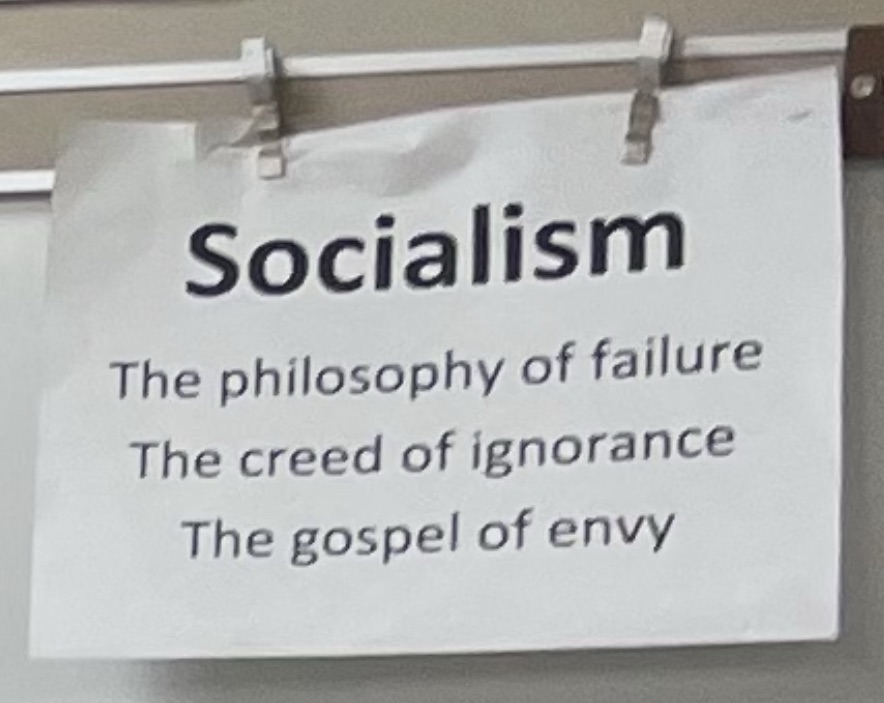
That training shapes how you see the world. It also makes one modern political phenomenon particularly difficult to understand: the continued appeal of socialism in the face of an overwhelming historical record of economic failure, social repression, and, in many cases, mass human suffering.
From the Soviet Union to Mao’s China, from Eastern Europe to more recent experiments in centralized control, the empirical pattern is not ambiguous. Systems organized around the concentration of economic power repeatedly generate misallocation, stagnation, and coercion to sustain the illusion of success. In any technical discipline, a design with this kind of failure history would be abandoned. Yet socialism persists—not merely as an idea, but as a recurring moral and political project.
The reason it persists is not because the evidence is weak. It’s because the argument is mismatched to the problem.
Socialism as Moral Myth, Not Technical Proposal
For many of its advocates, socialism is not primarily an economic system to be tested against outcomes. It is a moral narrative.
It offers a villain (capital, elites, “the system”), a moral injury (inequality), a redemptive act (seizing the means of production), and a utopian horizon (a just society beyond exploitation). Once an ideology becomes fused with moral identity, “I stand for justice, equality, the oppressed” empirical failure no longer functions as disconfirming evidence. Failure is simply reinterpreted as sabotage by outside actors, corruption, or insufficient ideological purity.
This is alien to how engineers are trained to think. In technical systems, repeated failure invalidates a model. In ideological movements, repeated failure often deepens belief, because belief is anchored not to performance but to moral intent.
Why Facts Don’t Persuade
This is why pointing to socialism’s historical record so rarely persuades its proponents. You are offering evidence about results. They are committed to a story about meaning.
People do not adopt ideologies primarily because of performance metrics. They adopt them because ideologies offer belonging, moral clarity, a framework for blame, and a promise of redemption. To someone seeking justice, facts, data and spreadsheets feel cold. To someone seeking meaning, moral narratives feel alive.
Facts matter. But facts alone are insufficient in a domain where identity, legitimacy, and moral purpose are at stake.
A Strange Return to a Wartime Book
One of the stranger experiences of trying to make sense of the political clashes and cultural chaos of the present moment is how often it drives you backward in time. In searching for frameworks that could explain why modern societies seem so vulnerable to ideological extremes, I found myself reading a book written in the depths of World War II.
James Burnham’s The Machiavellians: Defenders of Freedom was published in 1943, when the stakes of political failure were not abstract. Europe was burning. Totalitarian ideologies were not theoretical dangers but existential threats. Burnham was not writing from the comfort of historical hindsight, but from within a moment when political illusion had already produced catastrophe.
What struck me was not just the clarity of Burnham’s analysis, but how contemporary it felt. Despite being written over eighty years ago, his arguments about myth, elite decay, legitimacy, and the real mechanics of power map uncomfortably well onto our current moment. The language has aged; the dynamics have not.
There is something sobering about realizing that what feels like it was ripped from the headlines of today: polarization, institutional drift, ideological absolutism, was well understood in an era when the consequences were far more visibly catastrophic.
Burnham on Why Revolutions Actually Happen (And Why This Feels Uncomfortably Familiar)
Burnham’s central insight, drawn from Machiavelli, Mosca, Pareto, Michels, and Sorel, is that political life is governed less by ideals than by power relations and the behavior of leaders. Ideologies function as political formulas or simply widely held beliefs that justify who rules and why. When those beliefs lose credibility, societies enter periods of instability in which sweeping myths rush to fill the vacuum.
This is what worries me the most about the political climate of today, both sides view total victory as the only worthy outcome. Burnham could not be more explicit about the danger of total ideological victory:
“The absolute triumph of any doctrine can only mean tyranny.”
Liberty, in his view, is not preserved by the victory of a particular system, but by the continued competition among factions:
“Liberty is maintained not by the triumph of any class or doctrine, but by the continuing struggle between groups none of which can achieve complete domination.”
From this perspective, social revolutions are not the triumph of abstract ideals. They arise when the structure and psychology of ruling elites decay. Burnham outlined several preconditions under which revolutions tend to occur, each of which has uncomfortable resonance today.
1. Institutional failure to adapt to technological and social change.
When governance structures lag behind reality, political formulas lose credibility. Today’s rapid technological shifts—automation, digital platforms, AI, global capital mobility—often outpace regulatory and institutional adaptation, creating the perception that institutions no longer serve lived experience.
2. Elite withdrawal from the work of governing.
Burnham warned that ruling classes decay when they lose interest in the practical business of stewardship. Contemporary leadership often appears more invested in cultural signaling and moral performance than in the unglamorous maintenance of institutions, infrastructure, and productive capacity.
3. Elite closure and failure to absorb new talent.
Stable systems circulate elites. Closed systems stagnate. Credentialism, insider networks, and ideological conformity increasingly shape elite reproduction, eroding both competence and legitimacy. US leadership has continued to ossify, the faces in the Senate and Congress never seem to change, our Presidents only seem to get older and older.
4. Loss of confidence in political legitimacy and shared myths.
When no widely accepted political formula remains credible, authority becomes naked. The erosion of trust in institutions, media, and governance structures reflects a deeper collapse of shared legitimacy. Our universal belief in the unique promise embodied in the US and the global scale of human flourishing that Western Civilization unleashed is degraded and fragmented, we are losing the battle of ideas.
5. Reluctance to defend institutional authority.
Burnham observed that elites often lose not only the capacity but the will to rule. Today’s hesitancy to assert authority, replaced by endless proceduralism and obsessive apologies about the historical conditions that hurt some “disadvantaged” or “victimized” group creates an opening for absolutist movements comfortable with direct power.
These dynamics explain why ideological movements gain traction not because their models work better, but because incumbent elites hollow out the legitimacy of the systems they oversee. Myth rushes in where stewardship thins out.
A Competing Myth is Returning, Finally
This is what makes Marco Rubio’s recent speech in Munich so compelling, not as a policy blueprint, but as a signal. For the past few decades, defenders of the Western tradition have argued in managerial and technocratic language, or worse have claimed other categories of victimhood or grievances, while their critics have spoken in moral and civilizational terms. Rubio’s speech was a rare attempt to articulate, unapologetically, that Western civilization itself is a moral and historical achievement worth defending. I haven’t seen or heard anything close since Reagan left the scene.
What matters is not whether every claim can be reduced to a chart. What matters is the reemergence of a civilizational narrative: pluralism, rule of law, decentralized power, institutional competition, and the imperfect but demonstrable capacity of Western systems to generate human flourishing at scale.
This is precisely the terrain on which socialist mythologies operate. They offer moral redemption and historical cleansing. Against that, statistics about how low unemployment may be or one more policy announcement is no match. The contest is narrative before it is technical, who has the better story matters, a lot.
The Civilizational Case for the West
The Western tradition is not utopian. It does not promise the elimination of inequality or conflict. It accepts pluralism, tension, intense debate and most importantly; competition, as the price of freedom. It disperses power rather than centralizing it. It allows error correction without total rupture.
These are not emotionally intoxicating features. They are structurally resilient ones.
The historical record matters. Liberal, market-based societies, despite hypocrisy and repeated moral failure, have lifted more people, in more places, to higher levels of material well-being, technological capability, and personal agency than any alternative system yet devised. Not by promising paradise, but by building institutions that adapt, self-correct, and constrain the damage of error. It is well past time for apologies for the many imperfections and high time to focus on the enormous successes that far outweigh the flaws.
Retelling and Rebuilding a Story Worth Believing In
For those trained to build things in the real world, the persistence of failed political systems can feel like a collective refusal to learn. If a chemical process fails catastrophically often enough, the design is abandoned. In politics, failed systems survive as long as their stories remain compelling.
Socialism endures not because it works, but because it offers moral redemption to societies that have lost confidence in their own institutions. Burnham’s warning is that revolutions are incubated by elite decay, by the loss of competence, loss of legitimacy, and loss of confidence in the right to govern. When that decay sets in, myth fills the vacuum.
The defense of Western civilization is therefore not merely technical. It is moral, civilizational and essential. The real contest is not about the statistics of capitalism versus socialism, as that is no contest at all. It is myth versus myth: a utopian promise of purified justice versus a harder, humbler story of fragile freedom and imperfect progress.
Facts matter. Systems must work. But in political life, facts persuade only when they are nested inside a story about meaning, legitimacy, and purpose.
Engineers build systems that function.
Civilizations endure only when they remember why they exist.
If the West is to be renewed, defended, and reformed, it will not be through data alone. It will be because we are once again willing to tell—confidently and honestly—the story of what this tradition has achieved, what it costs to preserve, and why it remains worth believing in.


 Thinking On Energy
Leave a comment