

The world spent decades worrying about running out of crude. In 2026, the constraint has moved downstream.
A month ago, I wrote a piece called You Can’t Drill Your Way Out of a Hydrotreater Shortage. My argument was that crude oil prices had become a poor proxy for what was happening in the physical fuel market. Brent was getting most of the attention, but diesel cracks had crossed $100 a barrel, telling us that the ability to turn crude into finished products was becoming at least as important as the availability of the crude itself. The barrel coming out of the ground still mattered, of course, but the bottleneck was moving downstream.
Since then, the evidence has become considerably stronger, and the problem looks larger than a shortage of hydrotreating capacity. Last week, S&P Global Energy and the Transportation Energy Institute published a useful primer on the global movement of crude oil and refined products, highly recommended. Today, I had the opportunity to hear S&P’s Will O’Neil and Debnil Chowdhury, along with Tom Kloza of Gulf Oil, discuss how that system has behaved during the extraordinary disruptions of 2026.
What emerged from the discussion was a picture of a global refining and distribution system that has become extraordinarily efficient and interconnected, but also remarkably dependent on every part of the system continuing to work. We have crude oil. We have demand that, in many places, has actually declined. What we increasingly do not have is enough available refining capacity, product inventory and logistical flexibility to reliably put the right finished molecule in the right market at the right time.
Chowdhury summarized the situation better than I can: “We have less demand. But there’s even less supply and trade.” In a normal market, he noted, weak demand translates into weak refining margins. “That’s not the world we’re living in right now.” That distinction is the key to understanding what is happening.
America Produces Plenty of Fuel, Just Not Where We Need It
The United States provides a good example of how misleading national supply statistics can be. We are the world’s largest crude producer, largest refiner and largest fuel market. U.S. refineries processed about 16.4 million barrels per day of crude in 2025, and as a country we produced more gasoline, diesel and jet fuel than we consumed. Yet despite that bounty of production, both the East and West Coasts remain structurally dependent on imported finished products.
There is nothing mysterious about the reason. Roughly half of U.S. refining capacity is concentrated along the Texas and Louisiana Gulf Coast, while two of the country’s largest demand centers sit thousands of miles away on the coasts. Pipelines move enormous volumes of fuel from the Gulf Coast toward the East Coast, but not enough to completely satisfy demand, and the West Coast has no comparable pipeline connection to the Gulf. Marine transportation between U.S. ports is further constrained by the economics of Jones Act-compliant shipping. (note we do have a temporary waiver of the Jones Act right now that is helping.)

O’Neil described the result as a “fundamental problem” of moving fuel from where America produces it in surplus to where it consumes it in deficit. The easiest solution is pipeline transportation, he explained, but existing capacity is insufficient. Once that capacity is exhausted, marine transportation would be the logical alternative, except that Jones Act economics can make those movements commercially unattractive. The result is a structural dependence on foreign supply even though the country as a whole is long the same products.
In normal times, that arrangement works remarkably well. The East Coast pulls gasoline from Europe and Canada, the West Coast pulls gasoline and jet fuel from Asia, and the Gulf Coast sends its surplus into Latin America and increasingly Europe. Price moves molecules to where they are worth the most, and the global trading system quietly closes the gaps. But this year with two wars underway and more skirmishes like the Saudi – Houthi scuffle around the Red Sea expanding, the events of 2026 have shown us what happens when several of those gaps open at the same time and that wonderfully efficient global trading system cannot close them.
Before the Middle East disruption, about 186,000 barrels per day of jet fuel was moving from Asia to the U.S. West Coast, according to O’Neil, representing roughly 20 percent of that market. Much of it originated in South Korea, approximately 6,000 miles away. When crude flows through the Strait of Hormuz were disrupted, Asian refiners received less feedstock, reduced crude runs and consequently produced less jet fuel and gasoline available for export. Suddenly an airport in California had a direct supply relationship with events occurring half a world away.
The market responded impressively. Domestic movements increased, and West Coast refiners changed their product yields. Chowdhury noted that West Coast jet yield moved from roughly 21 percent to 23 percent, while the U.S. average was much lower. Two percentage points does not sound dramatic until you understand refinery economics; at that scale, it represents a meaningful redirection of the molecules coming out of the refinery. Those adjustments helped prevent the jet shortage that many feared earlier in the year.
The important point is that we did not create new refining capacity. We optimized, rerouted and drew down what we already had.
We Have Been Emptying the Tanks
That brings us to inventory. During the conference, Chowdhury estimated that the world has drawn roughly 570 million barrels of crude and refined-product inventories since the crisis began, approximately 200 million barrels of which came from strategic reserves. The United States increased exports, China reduced imports, refiners altered yields and strategic reserves supplied additional crude. Each adjustment relieved pressure somewhere in the system, but none of them actually restored the lost refining capacity.
This is where the distinction between inventory and production becomes important. Inventory is production from yesterday being consumed today. It can bridge a disruption, but it cannot permanently replace the production that has disappeared. Chowdhury described increased U.S. exports and reduced Chinese imports as two of the principal “relief valves” following the Hormuz disruption, but warned that both were beginning to close as U.S. inventories approached levels the market was increasingly uncomfortable drawing below and Chinese imports began recovering. So now we are seeing a hard decoupling of crude prices and product prices that do not have the inventory buffer to keep them from diverging.
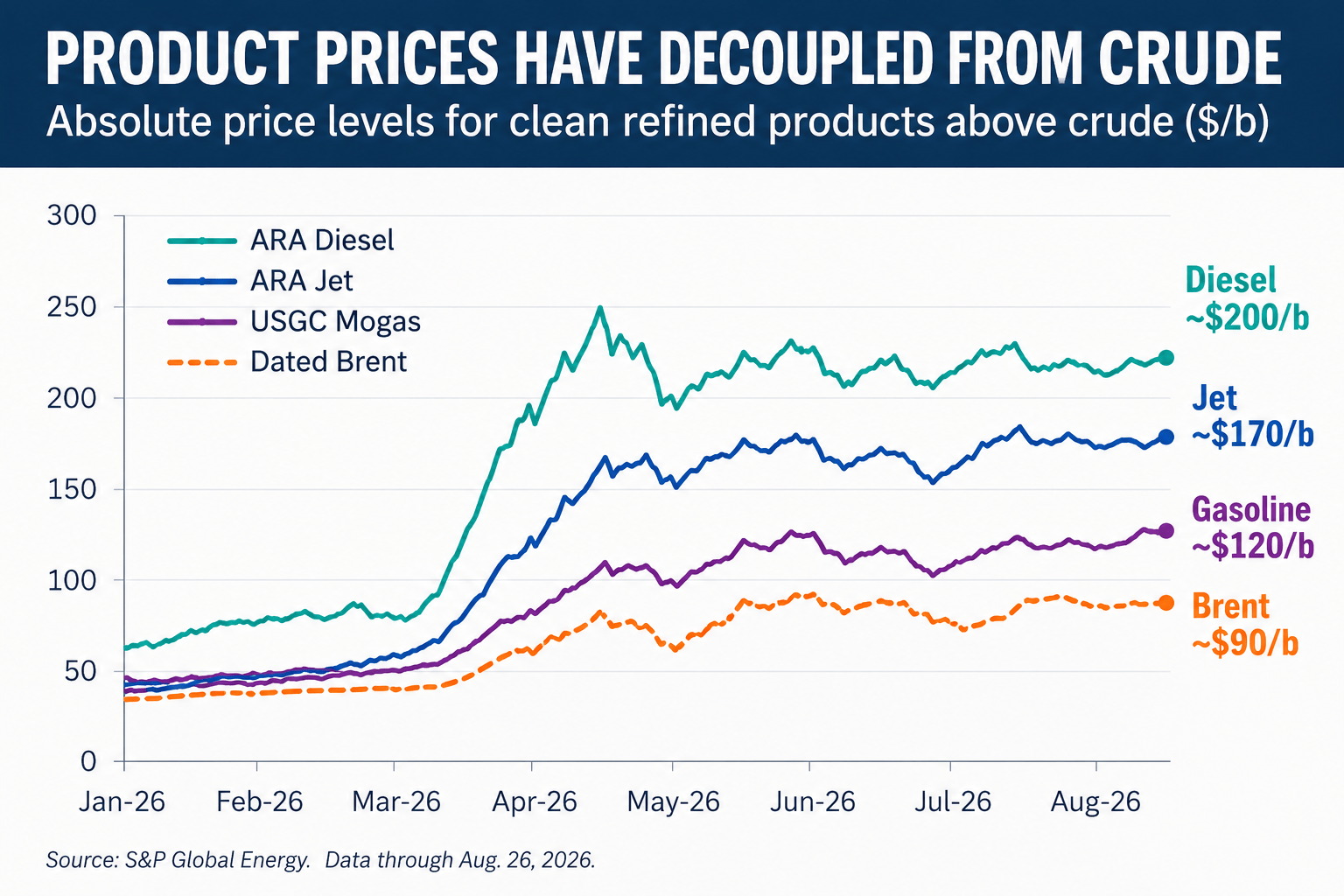
There is another problem embedded in those numbers that we discussed in the hydrotreater article. The world maintains substantial strategic reserves of crude oil but relatively little strategic inventory of finished products. As Chowdhury put it during the conference, “We don’t have a large product SPR globally, like we do a crude SPR.” That matters because crude in storage is only useful to the finished-product market if an operating refinery can process it. You can release crude from a salt cavern in Louisiana, but you still cannot put it into a Freightliner. Somebody has to turn it into diesel first.
The market is increasingly telling us that this conversion step is where the scarcity resides.
The Denominator Is Lying to Us
One of S&P’s charts from the conference may explain the current refining market better than anything else I have seen this year. At first glance, global refinery utilization does not look particularly alarming. Using reported nameplate capacity, effective utilization appears to be somewhere around 83 percent, a level that historically should not produce refining margins remotely resembling those we are seeing today. The problem is the denominator.
A 300,000-barrel-per-day Russian refinery with a damaged hydrotreater can remain in the calculation of global refining capacity even though that hydrotreater is no longer producing specification fuel. Middle Eastern capacity that has been damaged or shut in still exists on paper. Asian capacity without sufficient crude supply still has a nameplate bolted to the front gate. Counting all of it as available capacity creates the appearance of spare refining capability that does not actually exist.
Chowdhury was explicit about this point: “You need to not include damaged refinery capacity in the denominator.” Otherwise, he said, the market overestimates the amount of capacity refiners actually have available.
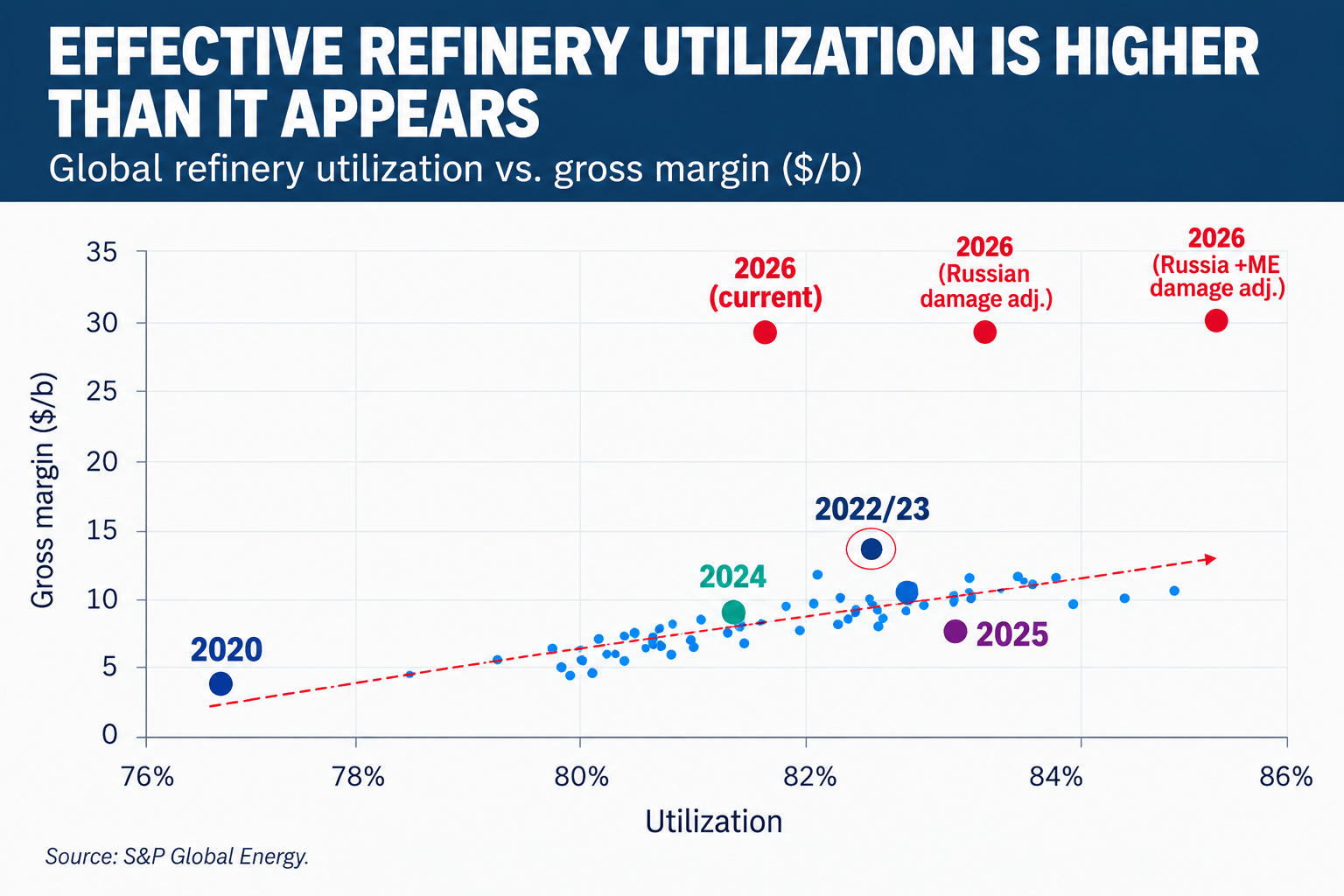
Once S&P removes unavailable Russian and Middle Eastern capacity from the calculation, effective global utilization moves toward 85 to 87 percent. Include other crude-constrained capacity and the remaining system is being pushed harder still. Chowdhury described this as moving into the “exponential part” of the utilization-versus-margin curve, where prices have to rise sufficiently to encourage every functioning refinery that has crude available to maximize production. This is an important extension of the argument I made in August. A refinery that exists on a spreadsheet but cannot run is not spare capacity, just as a hydrotreater that has been physically damaged does not become productive because crude prices fall.
Crude Is the Input. Diesel Is the Product.
This disconnect explains why crude oil is increasingly telling a different story from refined products. Kloza pointed out during the conference that the financial press remains preoccupied with whether crude is $85, $100 or $105 per barrel while paying considerably less attention to diesel trading at a barrel-equivalent value of roughly $200 to $225.
His explanation for that divergence is counterintuitive but physically straightforward. Kloza estimates that roughly 7 million barrels per day of global refining is currently unavailable for various reasons. Those missing refinery runs do not simply reduce the supply of finished products. They also reduce the amount of crude refiners need to buy.
As Kloza put it, “We’ve lost about 7 million barrels a day of global refining, and that means there’s 7 million barrels a day less demand for global crude.”
That means losing refining capacity can exert downward pressure on crude at exactly the same time it puts upward pressure on diesel, gasoline or jet fuel. There is no contradiction. Crude is the input and fuel is the output. If the machine between them stops working, demand for the input can decline while the value of the output rises.
Russia provides perhaps the clearest example. S&P says the market had been accustomed to roughly one million barrels per day of Russian diesel exports. That has fallen to around 100,000 barrels per day. Chowdhury’s assessment was striking: even without Russia’s diesel export ban, “Russia doesn’t have the diesel to export at this point” because domestic demand remains relatively high while refinery production has fallen sharply.
More troubling is what has been damaged. Recent attacks have increasingly affected refinery process units rather than simply pipelines and storage. Those are specialized pieces of equipment with much longer repair cycles. Chowdhury said S&P expects Russian refinery runs to remain affected at least through the first quarter of 2027 and acknowledged that continued disruption deeper into the year is entirely plausible. That distinction matters. A tanker can be rerouted. A damaged hydrocracker cannot.
The Coast Is Not Clear
The global problem becomes much more tangible when we return to the U.S. East Coast. National inventory statistics are useful, but fuel markets ultimately clear regionally. A barrel of diesel sitting in Houston does not necessarily help a distributor in Boston tomorrow morning, particularly when pipelines, ships and terminals connecting the two are already heavily utilized.
Kloza described what he sees developing as a possible “slow-motion inventory crisis.” During the conference he cited Lower Atlantic diesel stocks of roughly 6.6 million barrels and New England stocks around 2.3 million barrels, while emphasizing that the problem is larger than the inventory number itself. “It’s not just that we don’t have as much oil in storage,” he said. “We don’t have as much storage.”
That may prove to be one of the more important structural lessons from this episode. Just-in-time inventory and infrastructure rationalization look wonderfully efficient during normal conditions. Idle tanks, redundant terminals and spare refining capacity all carry costs. Over time, efficient markets tend to eliminate them. The consequence is that the same system becomes much less forgiving when several disruptions occur simultaneously, kind of like we are seeing right now.
The East Coast now has to compete for marginal barrels in an Atlantic Basin where Europe is structurally short diesel, Russian exports have collapsed and Middle Eastern supply has been constrained. U.S. refiners have responded by running extraordinarily hard and increasing exports, but even those additional American barrels have not fully restored European availability. The system is functioning exactly as a global commodity market should: price is pulling scarce molecules toward the markets willing to pay the most for them. The question is what happens when several large markets need the same marginal barrel at the same time. The other risk is that politics overcomes the price signals and the US succumbs to calls to limit diesel exports.
The Next Constraint May Be Maintenance
It would be tempting to conclude that all of this disappears when the geopolitical disruptions eventually subside. Some of it undoubtedly will. Damaged capacity will return, trade routes will adjust and sufficiently high prices will continue to suppress demand and attract supply. The difficulty is that the refineries carrying the load today are machines, not perpetual-motion devices. The United States and Europe we have been running available plants extremely hard precisely because margins have told us to do so. Maintenance can be postponed during an emergency, but it cannot be eliminated.
Kloza said conversations with major refiners suggest 2027 could bring “the most extensive refinery turnaround season…in a generation” because so much maintenance has been deferred while utilization remains exceptionally high.
That creates an uncomfortable transition. The industry could move from involuntary refinery outages caused by war and physical damage into planned outages required to maintain the refineries that carried the system through those disruptions. S&P’s current outlook therefore does not envision an immediate return to the old market. Chowdhury said 2027 still appears very tight, with something resembling normalization potentially emerging around the middle of 2028.

Then he posed what may be the most important question from the entire discussion: “The question is, what is normal?”
We have spent much of the last fifteen years discussing energy security through an upstream lens. We count rigs, estimate shale productivity, debate OPEC spare capacity, measure crude inventories and ask how quickly producers can put another well online. Those remain important questions, but 2026 is reminding us that energy security does not end when crude comes out of the ground.
It requires the refinery that converts the crude, the hydrotreater that makes the diesel meet specification, the pipeline or ship that moves the product, the terminal that stores it and enough inventory throughout that chain to absorb the inevitable moment when one of those pieces stops working. Remove enough redundancy in the pursuit of efficiency and eventually the system begins to depend on everything working almost all of the time.
Last month I wrote that you cannot drill your way out of a hydrotreater shortage. Turns out that what has happened since suggests that the hydrotreater was really just the first visible symptom of a larger constraint.
We have spent decades making the global fuel system extraordinarily efficient. What 2026 is testing is whether we also made it too efficient to fail gracefully. It’s sure going to be an interesting winter.