

The world has a diesel shortage. That much is obvious. Prices have reached historic highs, inventories are scraping the bottom of seasonal ranges, and disruptions across Russia and the Middle East have removed substantial volumes of refined products from global trade. What concerns me is what happens next.
Refineries have been operating under extraordinary pressure to maximize production, and some operators have responded to strong margins by postponing scheduled maintenance. That keeps fuel flowing today, but it also creates a maintenance obligation that eventually must be addressed. We may be approaching a period when the market expects refinery production to recover just as more equipment needs to come offline.
The diesel shortage is not necessarily over when the disrupted refineries restart. We also have to account for the maintenance that has been postponed while the world was running short of fuel.
Cheap Crude, Expensive Everything You Can Actually Burn
The distinction between crude oil and refined products has rarely been more important. The Energy Information Administration’s October outlook forecasts Brent crude averaging approximately $105 per barrel in the fourth quarter of 2026 before declining to $84 in 2027.
At the same time, U.S. retail diesel averaged $6.29 per gallon in September. Even with its forecast for declining crude prices, the EIA expects diesel to average approximately $4.49 per gallon next year. If these forecast turn out to be even close to actual prices over the next year the implied forward crack spreads look to remain extremely generous, not the record margins refiners have had this year, but still far beyond any typical historical spread.
The agency explicitly identifies extreme diesel market tightness as a source of additional demand for crude oil. This is a reversal of how most people think about petroleum markets. Ordinarily, we talk about crude prices driving product prices. Today, the scarcity of finished products is actually helping pull crude prices higher, this price action is more about demand than supply.
The International Energy Agency puts some staggering numbers behind that relationship.
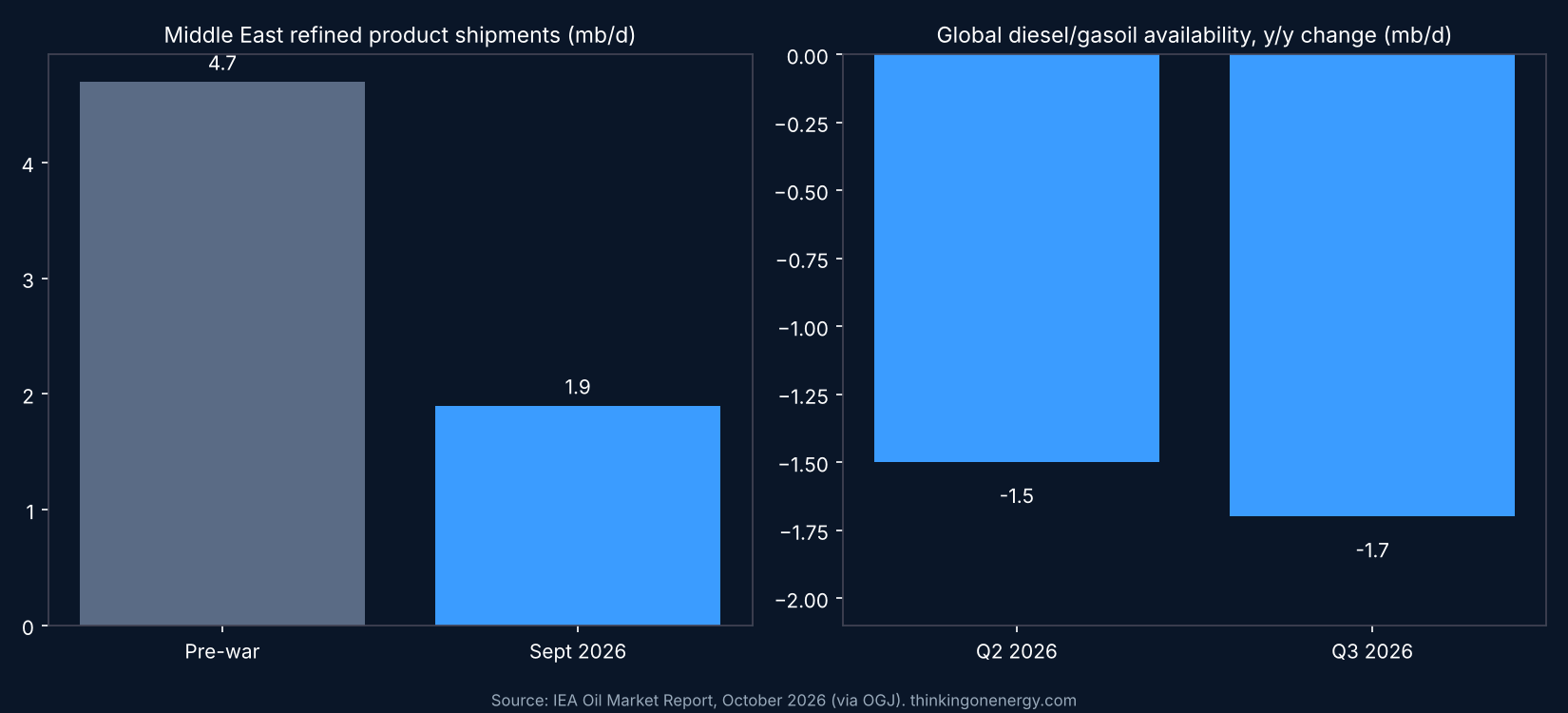
Global diesel and gasoil availability was 1.5 million barrels per day below year-earlier levels during the second quarter and 1.7 million barrels per day lower during the third.
Diesel benchmarks exceeded $200 per barrel in September. Even after retreating from their peaks, diesel prices remain nearly double crude oil prices in several major markets. The signal is unmistakable, The world needs more finished diesel, not simply more crude oil.
Unfortunately, those are not interchangeable barrels.
Two Big Holes in the Refining System
The first problem is Russia.
Ukrainian drone attacks have repeatedly disrupted Russian refineries, damaging equipment and reducing the country’s ability to produce and export diesel.
Russia’s diesel exports have fallen sharply this year. Although shipments have begun returning to destinations including Turkey and Brazil following the easing of export restrictions in October, the underlying refining constraints have not disappeared.
The IEA estimates that combined diesel and gasoil exports from Russia and the Middle East fell by approximately 1.3 million barrels per day in September compared with a year earlier. That lost supply matters far beyond the countries experiencing the disruptions.
Europe no longer relies on direct Russian diesel imports, but traditional buyers in Africa and Latin America must compete for alternative barrels. That pushes demand toward the United States, the Middle East and other exporting refiners.
The second problem is the Persian Gulf.
The IEA reports that Middle East refined-product exports recovered to only 1.9 million barrels per day in September, compared with approximately 4.7 million barrels per day before the conflict. Meanwhile, total oil flows through the Strait of Hormuz recovered to 10.9 million barrels per day.
That difference is enormous and shows clearly that crude movements can recover faster than refinery operations, product exports and the transportation networks needed to deliver finished fuels.
The Maintenance Bill Is Coming Due
This is the part of the diesel story I believe deserves more attention. Refineries are complicated collections of interconnected process units. They are not machines you can operate indefinitely at maximum capacity.
Crude distillation units, hydrotreaters, hydrocrackers, cokers and associated equipment require periodic maintenance. Catalysts lose activity. Heat exchangers foul. Corrosion takes its toll. Compressors and rotating equipment require inspection and repair. Eventually, equipment must come offline.
Refiners carefully schedule these shutdowns, what we call turnarounds, to minimize lost production while addressing mechanical integrity, regulatory requirements and process performance. The scheduling decisions become particularly difficult when refining margins are exceptional, like they have been for the past six months.
Every day a plant is offline represents a substantial opportunity cost and at this years crack spreads you simply would not bring the plant down unless it was absolutely necessary. So every operator has been looking for ways to extend runs, defer discretionary work and move maintenance into a more favorable operating window.
There is nothing inherently wrong with that. Many facilities can safely extend operating cycles within established mechanical-integrity and inspection requirements. But postponed maintenance does not simply disappear, you are simply borrowing capacity from the future.
Eventually, catalyst activity declines, equipment performance deteriorates, or inspections and repairs can no longer be deferred. We now have evidence that refiners have and are shifting some of that work into future operating periods.
Industrial Info Resources reported in September that planned turnarounds at 10 crude units across seven U.S. refineries had been moved from fall 2026 into fall 2027. Its analysis also showed planned U.S. crude-unit outages for fall 2026 running approximately 144,000 barrels per day below earlier schedules, while planned fall 2027 outages had increased by approximately 283,000 barrels per day.
Those figures do not establish a global maintenance crisis. They do establish that maintenance deferrals are happening and they raise an important question. How much of today’s refinery production is being sustained by borrowing operating time from tomorrow?
Many are assuming that if we get the strait open and oil flowing that our refined products shortage will somehow instantly end. That’s far too simplistic an outlook and the issue becomes especially important for diesel because refinery capacity is not one homogeneous number.
A refinery might have available crude-processing capacity but insufficient downstream upgrading capacity to turn the resulting intermediate streams into the products consumers need.
Hydrotreaters remove sulfur to meet ultra-low-sulfur diesel specifications. Hydrocrackers upgrade heavier molecules into valuable middle distillates. Those units have their own constraints, operating cycles and maintenance requirements. Taking a critical hydrotreater or hydrocracker offline can reduce a refinery’s ability to produce specification diesel even when other portions of the plant continue operating.
That is why I would pay particular attention to the availability of individual process units rather than simply looking at headline crude-distillation capacity. The IEA currently expects global refinery runs to fall to a seasonal low of 81.3 million barrels per day in October before recovering to 84.6 million by year-end.
That is a significant recovery, but it also assumes the global refining system can increase throughput despite ongoing disruptions, normal maintenance requirements and the operational complications of restarting damaged facilities. The IEA already expects diesel markets to remain tight well into 2027, even with improving refinery output.
My concern is that postponed maintenance could make that recovery less reliable than the headline numbers suggest. Not every delayed turnaround will occur next spring. Some work has already shifted into late 2027. The timing remains uncertain. But the underlying physical reality does not change.
Every refinery has a maintenance calendar, and the market cannot indefinitely trade around it.
Inventories Leave Very Little Room for Error
Normally, inventory helps absorb production disruptions and headed into winter we would expect to see distillate inventories building. This year despite the strongest price signal our market has ever seen, that buffer remains unusually thin.
The EIA reported that East Coast distillate inventories were 32% below their five-year seasonal average in September. It expects inventories to remain approximately 20% to 30% below normal during the coming winter. Nationally distillate inventories fell to exceptionally low seasonal levels during the summer.
While weekly stocks have recovered somewhat, the overall supply position remains constrained. The IEA reports that global onshore oil inventories are no better, and have fallen to their lowest levels since at least 2016. These shortages are already imposing real economic consequences on trucking, farming, and basically any commercial activity.
Heating oil prices entering winter are more than 30% higher than last winter, according to the EIA. When inventories are comfortable, a refinery outage may barely register outside the immediate market. But, when inventories are depleted, the same outage can trigger price spikes, transportation disruptions and frantic competition for available supply.
That is the environment we are entering.
What Could Break the Shortage?
There is an important counterargument to my thesis. Demand destruction works. The IEA forecasts global oil demand declining by 2.6 million barrels per day in 2026 as high prices and weakening economic activity weigh on consumption. That is a substantial reduction.
The agency also expects some recovery in global refinery production and a gradual improvement in diesel supply during 2027. A sustained recovery in Middle Eastern product exports, repairs to damaged Russian facilities, and the release of emergency government stocks could all improve the outlook faster than I anticipate, but all of those factors aligning, all at the same time looks very unlikely to me.
We should also recognize that diesel and gasoil demand is not immune to high prices. Consumers can defer purchases, economic activity can slow, and industrial users can reduce operations. But there is an important distinction between eliminating a shortage by increasing supply and eliminating it by destroying demand.
One is an economic recovery. The other is economic damage. My confidence is greater in the existence of deferred maintenance than in precisely when that maintenance will constrain global production. The evidence supports a serious risk, not a guaranteed outcome.
What This Means If You Buy, Burn or Move Diesel
The practical implications of this situation while fascinating to us in the industry, extend well beyond refiners and traders. For companies operating truck fleets, construction equipment, farms or diesel-dependent supply chains, the assumption that lower crude prices automatically translate into rapidly declining diesel costs deserves scrutiny, especially when politicians start clamoring for drastic measures like a diesel export ban.
The EIA also expects crude prices to fall significantly in 2027. That may happen. But if refining capacity remains constrained, diesel crack spreads can stay elevated even as crude prices decline.
For fuel marketers and distributors, the risk is not simply price volatility. It is the ability to secure physical supply when inventories are low and transportation networks are stretched.
For policymakers, proposals to restrict fuel exports may sound appealing domestically, but they can further disrupt the global product flows on which importing regions depend.
For investors, the relevant question is not merely how much refining capacity exists. It is how much capacity can reliably operate, what products that capacity can manufacture, and when critical units must be removed from service.
Those of us that have spent enough time around refineries to know that maintenance schedules are not optional forever. A hydrotreater does not care about the futures curve. A compressor does not respond to an economist’s forecast, and a delayed turnaround does not become unnecessary simply because the market needs another month of production.
The global diesel market is already operating with limited room for error. We should be paying close attention to how much maintenance is being postponed, where that work is accumulating, and whether the expected recovery in refinery throughput can actually be delivered. Because the next chapter of this diesel shortage may not be written in the oil fields or on the trading screens.
It may be written on the maintenance schedules of the world’s refineries.
Sources and Further Reading
- International Energy Agency — Oil Market Report, October 14, 2026
https://www.iea.org/reports/oil-market-report-october-2026 - U.S. Energy Information Administration — Short-Term Energy Outlook, October 6, 2026
https://www.eia.gov/outlooks/steo/ - U.S. Energy Information Administration — Weekly Petroleum Status Report, October 21, 2026
https://www.eia.gov/petroleum/supply/weekly/ - Industrial Info Resources — Some U.S. Refiners Deferring Maintenance from 2026 to 2027, September 17, 2026
https://www.industrialinfo.com/iirenergy/industry-news/article/some-us-refiners-deferring-maintenance-from-2026-to-2027–362613 - Reuters — Russian diesel returns to Turkey, Brazil after export ban lifted, October 20, 2026
https://www.reuters.com/business/energy/russian-diesel-returns-familiar-destinations-following-export-ban-lift-shipping-2026-10-20/